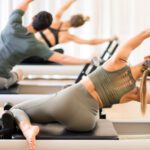
Joseph Pilates believed that physical fitness was not simply a matter of strength, but of developing control over the body. Few abilities reflect this idea more clearly than balance.
While many people associate balance with standing on one leg, balance is actually a complex process that depends on the coordination of multiple systems working together at the same time. This is one reason balance often changes with age.
The visual system provides information about our surroundings. The vestibular system of the inner ear helps us sense changes in head position and movement. Sensory receptors in our muscles, joints, and connective tissues provide feedback about where our body is in
space. Together, these systems help the brain make countless adjustments that allow us to remain upright and move efficiently. Many people notice, for example, that balancing becomes more difficult when they close their eyes. This simple experience demonstrates how much information the brain receives from vision to help maintain stability.
Pilates places a strong emphasis on developing proprioception—the body’s ability to sense its position and movement in space. The nervous system relies on a continuous stream of information from the eyes, inner ear, muscles, joints, and connective tissues to help us navigate our environment. The richer and more accurate this information is, the more effectively the body can respond to changing movement demands. This is why mindful movement practices play such an important role in maintaining balance throughout life.
This perspective is reflected throughout Pilates. Balance is rarely trained in isolation. Every transition from lying down to sitting, from sitting to standing, or from one exercise to the next challenges the body to organize itself in space. Exercises performed in different positions, planes of motion, and levels of support encourage the nervous system to continually adapt and refine movement strategies.
In many ways, Pilates treats balance as a dynamic skill rather than a static achievement. Standing on one leg may be one expression of balance, but so is rolling up from the mat, coordinating breath with movement, or shifting weight from one side of the body to the other. These experiences challenge the body to make small adjustments while remaining responsive to change.
Perhaps one of the most valuable lessons Pilates teaches is that balance is not a fixed ability. It is a skill that can be practiced. Just as strength and mobility can improve with consistent training, balance responds to movement experiences that challenge awareness, coordination, and adaptability.
Life rarely unfolds under perfectly controlled conditions. We step onto uneven surfaces, carry groceries, reach for objects, navigate crowds, and respond to unexpected changes in our environment. Balance helps us meet these challenges with confidence. By continuing to move in varied and intentional ways, we support the body’s remarkable ability to adapt, respond, and move through life with greater ease.
Any content, resident submissions, guest columns, advertisements, and advertorials are not necessarily endorsed by or represent the views of Best Version Media LLC (BVM) or any municipality, homeowners associations, businesses, or organizations that this publication serves. BVM is not responsible for the reliability, suitability, or timeliness of any content submitted, inclusive of materials generated or composed through artificial intelligence (AI). All content submitted is done so at the sole discretion of the submitting party.