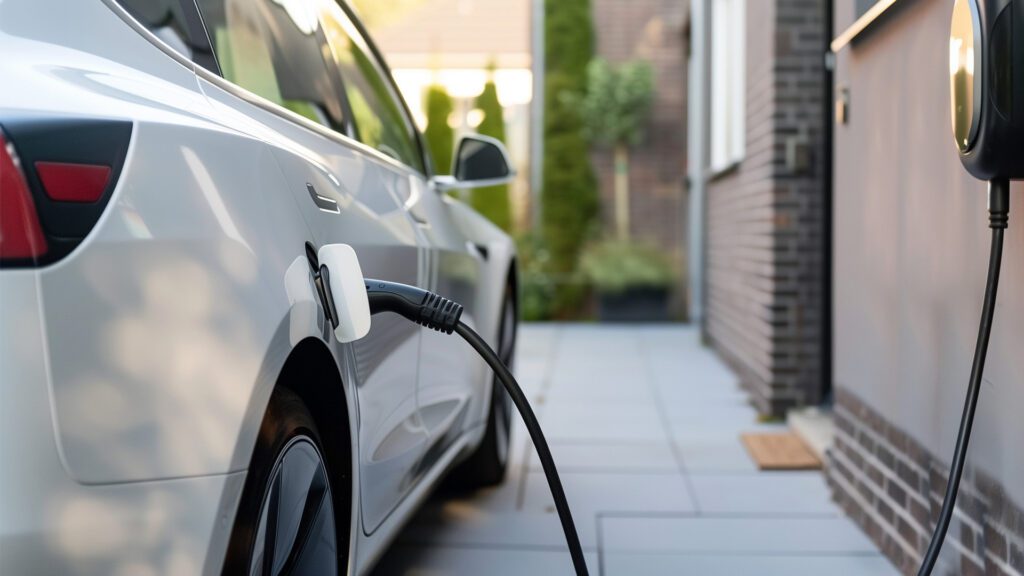
Your Garage May Be the New Gas Station, But Is Your Electrical Service Ready?
There was a time when a finished basement, backyard pool, or beautiful kitchen was the “wow” feature of a home. Today, an EV charger is quickly joining that list. Electric vehicles are becoming a familiar sight on Long Island, and the convenience is hard to argue with: pull into the garage, plug in, go to sleep, and wake up ready to drive. No gas station. No waiting. Just charge and go. But while charging an EV may feel simple, installing the equipment safely involves considerably more than mounting a charger on the wall.
Your Electrical Service HAS to Be Ready
Many homeowners don’t realize that EV chargers can place a significant, continuous demand on a home’s electrical system. A standard 120-volt outlet can charge an EV, but slowly. Level 2 chargers operate at higher voltage and can charge significantly faster, but they also require a properly sized, dedicated circuit.
Before installation, an electrician may need to evaluate:
- The home’s electrical service capacity
- The existing panel and available breaker space
- Overall electrical load
- Circuit and wire sizing
- Grounding and bonding
- Charger location and installation method
- Applicable codes, permits, and inspections
And here’s an important detail: an empty spot in your electrical panel doesn’t necessarily mean your home has enough electrical capacity. Load calculations truly matter. Think of your electrical service like a highway. Your appliances, heating and cooling systems, lighting, kitchen equipment, and other electrical loads are already using that highway. An EV charger adds another vehicle to the road and potentially a fairly large one. A proper load calculation helps determine whether your electrical system can safely accommodate the additional demand. Sometimes the answer is simple: the existing system is ready. Sometimes it isn’t. That could lead to a panel upgrade, service upgrade, or another solution designed specifically for the property.
The Part Homeowners Don’t See
When a homeowner buys a new EV, purchases a charger, finds the perfect spot in the garage, they assume installation will be straightforward. Then someone looks inside the electrical panel and discovers that the house is already carrying a substantial electrical load. Suddenly, the conversation isn’t just about installing a charger. It’s about understanding the entire electrical system. That’s an important lesson; every home is different. Two houses on the same street can have completely different electrical requirements based on their age, service size, equipment, wiring, and existing loads.
Looking Beyond Today’s Car
EV charging is more than a convenience upgrade. It’s part of a larger shift in how homes use electricity. As transportation becomes increasingly electric, homeowners are asking their electrical services to do more than ever before. That’s why proper planning matters. An EV charger should be viewed as part of the home’s electrical infrastructure, not simply another appliance. The charger may be what you see on the garage wall, but the real work is understanding everything behind it. And when electricity is involved, what’s behind the wall matters.
Any content, resident submissions, guest columns, advertisements, and advertorials are not necessarily endorsed by or represent the views of Best Version Media LLC (BVM) or any municipality, homeowners associations, businesses, or organizations that this publication serves. BVM is not responsible for the reliability, suitability, or timeliness of any content submitted, inclusive of materials generated or composed through artificial intelligence (AI). All content submitted is done so at the sole discretion of the submitting party.