Education is most meaningful for students when they understand that learning does not exist in isolation. The questions they encounter in everyday life are complex, interconnected, and rarely belong to a single subject area, and our approach to learning should reflect that reality.
At Glen Briar Academy, we see this every day. Children naturally make connections across disciplines as they explore questions, ideas, and experiences. Our role as educators is to create learning opportunities that allow those connections to develop in meaningful and purposeful ways.
Transdisciplinary learning provides a different approach to how learning can be organized, and moves beyond simply teaching several subjects centred around a common topic. The International Baccalaureate (IB) describes transdisciplinary learning as learning that has relevance “between, across, and beyond subjects” and connects to what is real in the world. Rather than beginning with the boundaries of an individual subject, learning begins with a meaningful concept, question, issue, or problem. Transdisciplinary learning invites students to draw on previous knowledge, skills, and perspectives from across disciplines to investigate questions, solve problems, and understand the world around them. Mathematics becomes a tool to interpret information, while literacy provides students with the opportunity to research, communicate, and support their thinking. Science encourages them to investigate, hypothesize, and question, while the arts provide another way through which ideas can be expressed and shared. Disciplines remain important, but students begin to understand the ways in which and the reasons why they work together.
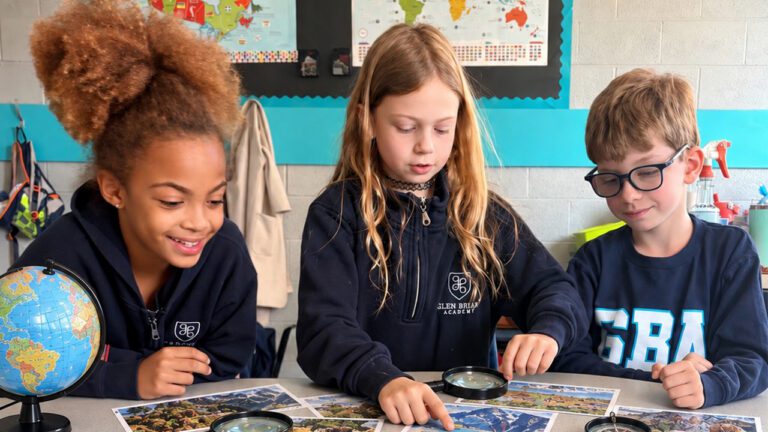
An inquiry into why a plant grows in a certain environment but not another soon becomes an exploration of science, geography, measurement, environmental responsibility, and communication. A conversation about what makes a community welcoming can lead students to explore literature, history, identity, citizenship, art, and social responsibility. Children, when given the opportunity, make these connections naturally as they do not experience the world as a collection of separate subjects.
Yet, historically, schools have often organized learning in exactly this way; by dividing knowledge into distinct disciplines with boundaries that have traditionally been “clearly bounded and well-insulated from each other” (Bernstein, 1971, as cited in Hordern et al., 2021). However, more recently, transdisciplinary approaches have questioned and challenged these traditional curricular boundaries by organizing learning around authentic, real-world problems that require students to draw upon knowledge from multiple disciplines (Bernal-Castañeda et al., 2025)
This is not to suggest that strong disciplinary knowledge and skills are any less important. Students need explicit instruction, opportunities to practise foundational skills, and increasingly sophisticated knowledge within individual subject areas. But if education stops there, we risk teaching students to acquire knowledge without necessarily teaching them how to connect, transfer, and use it.
To learn more about how transdisciplinary learning helps students become well-rounded, knowledgeable, and engaged learners, visit our new website at www.glenbriaracademy.com.
References
Bernal-Castañeda, A., Gómez-Hurtado, I., & García-Rodríguez, M. P. (2025). Transdisciplinarity in Education: A Narrative Review of Its Didactic Validity and Contributions to Sustainable Learning. Sustainability, 17(22), 10320.
Hordern, J., et al. (2021). “Curriculum Integration and the Semicentennial of Basil Bernstein’s Classification and Framing of Educational Knowledge.”
International Baccalaureate Organization. (2026, February 19). Learning and teaching. International Baccalaureate. www.ibo.org/programmes/primary-years-programme/curriculum/learning-and-teaching
Any content, resident submissions, guest columns, advertisements, and advertorials are not necessarily endorsed by or represent the views of Best Version Media LLC (BVM) or any municipality, homeowners associations, businesses, or organizations that this publication serves. BVM is not responsible for the reliability, suitability, or timeliness of any content submitted, inclusive of materials generated or composed through artificial intelligence (AI). All content submitted is done so at the sole discretion of the submitting party.