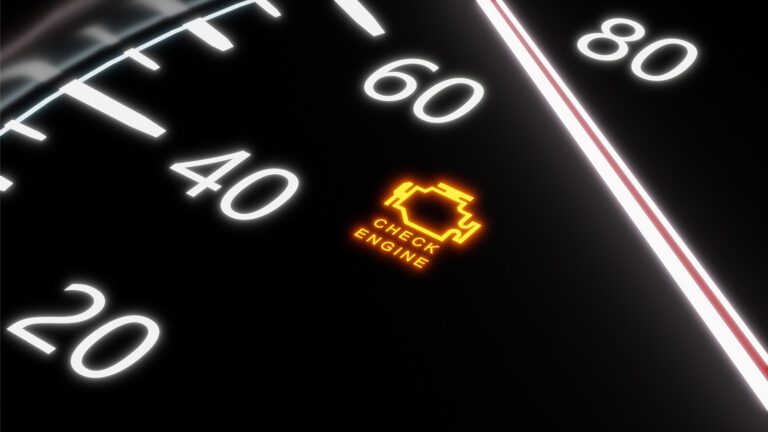
As a Lake Norman local and a Certified Auto Repair shop owner, I’ve seen just about every driver reaction imaginable when that dreaded yellow symbol illuminates on the dashboard.
Over the years, our customers generally fall into three camps:
The Panic Drivers: They call in a sweat, convinced their vehicle is moments away from failing on Charlotte Highway or coasting to a dead stop along I-77.
The Unconcerned Drivers: They spot the light, shrug, and continue commuting for another six months—or until the engine starts sounding like a blender full of marbles.
The “In The Middle” Drivers: They see the light and think, “I should probably do something about that… maybe tomorrow.”
The truth about your Check Engine Light (CEL) lies between these extremes. It isn’t an immediate death sentence for your car, but it certainly isn’t something to ignore.
Steady vs. Flashing: The Golden Rule
Understanding what your light is telling you comes down to one simple distinction:
Solid Yellow Light: This is your car saying, “I’ve detected a glitch and need a check-up.” It signals a necessary fix, but not an immediate emergency. You can safely finish your errands, but schedule an inspection within a few days.
Flashing Light: This is a genuine red alert signaling an active engine misfire. Unburnt fuel is dumping into your exhaust, which can destroy your catalytic converter in minutes—turning a minor repair into a multi-thousand-dollar overhaul. Pull over safely, turn off the engine, and call for a tow.
What Triggers the Light?
Each malfunction stores a related fault code in memory, but knowing the code isn’t the same as knowing the cause.
Today’s vehicles rely on a network of 30 to 50 individual computers monitoring 100 to 200 sensors, processing roughly 20 Gigabits of internal data every second. The light turns on whenever readings fall outside normal parameters. Because one code can result from several failures, an accurate diagnosis is essential.
Common culprits include:
A Loose Gas Cap: A loose cap disrupts pressure in the evaporative emission control (EVAP) system, though it’s only one of several components that trigger this code.
Oxygen (O2) or Mass Air Flow Sensors: Worn sensors prevent the computer from properly balancing the air-to-fuel ratio, reducing fuel efficiency and acceleration.
Ignition Coils or Spark Plugs: Worn plugs cause misfires, leading to rough idling and loss of power.
Catalytic Converter Failure: Often the result of ignoring lesser issues for too long.
The True Cost of Waiting
Ignoring a steady light might seem harmless if your car feels fine, but internal systems suffer silently. An unaddressed problem forces your engine to run inefficiently, burning extra fuel and accelerating wear on major components.
Think of your Check Engine Light as an early-warning communication tool. Addressing a minor warning promptly keeps fixes simple and prevents major repairs down the road—ensuring your drives around Lake Norman remain smooth, safe, and stress-free.
Honoring our Veterans
Thank you for your service and God bless. As always, we offer our Veterans a 10% discount (up to $500 off) on all services and repairs! Share your story and let us know about your service, military branch, any areas of specialty and where you were stationed!
Any content, resident submissions, guest columns, advertisements, and advertorials are not necessarily endorsed by or represent the views of Best Version Media LLC (BVM) or any municipality, homeowners associations, businesses, or organizations that this publication serves. BVM is not responsible for the reliability, suitability, or timeliness of any content submitted, inclusive of materials generated or composed through artificial intelligence (AI). All content submitted is done so at the sole discretion of the submitting party.