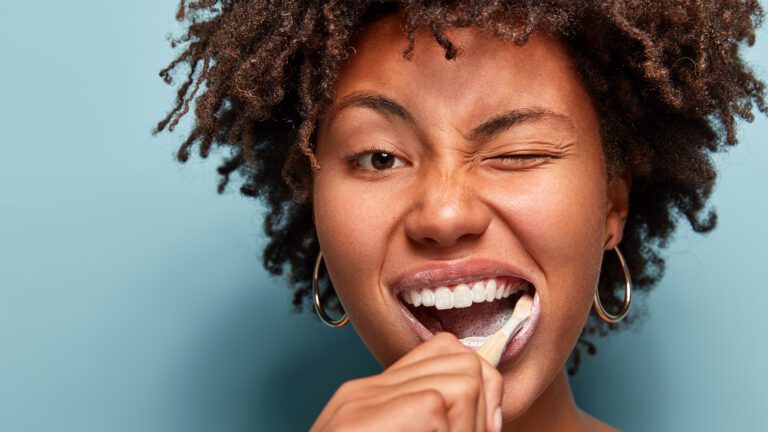
Could coconut oil, charcoal toothpaste, or a whitening kit give you a healthier, brighter smile? With so many products promising results, it is reasonable to wonder what works and whether something from the store could be as helpful as professional care.
My approach is to keep an open mind while asking three questions: Does it work? Is it appropriate for your mouth? Is there a better way? You deserve clear answers, not judgment for being curious.
Oil Pulling: Promises Versus Proof
Oil pulling involves swishing coconut or sesame oil around the mouth and spitting it out. Some small studies suggest improvements in plaque or gum inflammation, but much of the research is short term, and the evidence remains uncertain. A short-term change in plaque does not prove lasting protection against dental disease.
Reliable evidence does not establish that oil pulling prevents cavities, treats established gum disease, whitens teeth, or “detoxifies” the body. The American Dental Association does not recommend it as a dental hygiene practice.
For dry mouth, oil may temporarily improve comfort. However, one small study did not clearly demonstrate better overall dryness relief than water. Comfort is not the same as restoring normal saliva production. Persistent dryness deserves evaluation, not simply a home remedy.
I do not recommend oil pulling for disease prevention. It should never replace brushing, cleaning between teeth, or necessary treatment. As a precaution, I advise against it for children and people with swallowing difficulties. Published case reports describe serious lung inflammation after oil entered the lungs; they do not establish how often this happens.
Charcoal: Surface Cleaning Is Not Bleaching
Removing coffee or tea stains from the surface is not the same as lightening the natural color inside a tooth. Some charcoal toothpastes remove surface stains, but convincing evidence of superior whitening is lacking. Peroxide bleaching has stronger support for lightening natural teeth.
Abrasiveness varies by formula. Not every charcoal toothpaste damages enamel. Nevertheless, I discourage loose powders and homemade mixtures, where safety and performance may be poorly characterized. Patients with exposed roots, sensitivity, veneers, crowns, or bonding should discuss abrasive whitening products with our team.
Read the label. Some charcoal toothpastes contain fluoride; others do not. Fluoride helps protect against cavities. Charcoal has not demonstrated an equivalent benefit. A suitable fluoride toothpaste containing charcoal may be acceptable, but that does not make charcoal the reason to choose it. The finished formula matters more than marketing.
Whitening at Home or in the Office?
When patients ask whether to whiten at home or in the dental office, I explain that faster does not necessarily mean whiter. In-office treatment can provide a quicker initial change, while dentist-supervised take-home trays can achieve comparable final results over a longer course. Peroxide whitening strips can also be an effective, lower-cost option for suitable patients. The right choice depends on your dental health, sensitivity, budget, and expectations. At our office, we evaluate the cause of discoloration and review any crowns, veneers, or fillings—which will not whiten like natural teeth—before recommending treatment. Both home and office treatments can cause temporary sensitivity. My advice: choose a personalized plan—not the strongest gel or the biggest “shade change” promise.
Remember that “at home” describes two different choices: products you select yourself and professional treatment using dentist-provided trays and a prescribed schedule. Treatment does not stop being professional simply because you use it outside the office.
Custom trays fit your teeth and let us adjust instructions to your needs. Office treatment includes protection for surrounding tissues. Neither approach should be judged by peroxide strength alone; concentration, contact time, and your tolerance all matter.
Follow the instructions rather than applying more gel or extending treatment on your own. Persistent pain or gum irritation is a reason to stop and contact our office. Advertised shade changes are not guarantees for your smile.
What I Recommend
Start with the basics: brush gently for two minutes twice daily using fluoride toothpaste, clean between teeth daily, and follow an individualized schedule for dental visits. Look for the ADA Seal of Acceptance when choosing toothpaste.
Before buying something new, bring the product or a photograph of its label to your dental visit. Tell us what you hope it will accomplish and what you currently use. Sometimes the best recommendation is a simpler routine. My goal is appropriate care that meets your individual needs, not the most expensive option.
My bottom line: a healthy, attractive smile does not require chasing trends. Be curious but let evidence guide the decision. The best care is not necessarily the newest or most expensive. It is the care that safely meets your needs, consistently.
Any content, resident submissions, guest columns, advertisements, and advertorials are not necessarily endorsed by or represent the views of Best Version Media LLC (BVM) or any municipality, homeowners associations, businesses, or organizations that this publication serves. BVM is not responsible for the reliability, suitability, or timeliness of any content submitted, inclusive of materials generated or composed through artificial intelligence (AI). All content submitted is done so at the sole discretion of the submitting party.