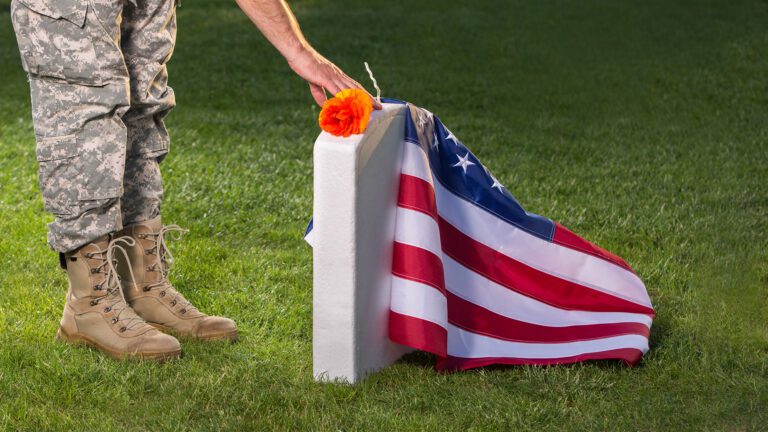
When a veteran passes away, families often want to ensure their loved one’s service is recognized in a meaningful and respectful way. Understanding available burial benefits and military honors can make an emotional process a little easier.
Veterans who served in the U.S. Armed Forces and meet applicable service and discharge requirements may qualify for VA burial benefits. Active-duty service members who die while serving may also qualify, as may certain National Guard and Reserve members, depending on their service history. Eligible spouses, surviving spouses, and dependent children may also qualify for burial in a VA national cemetery.
One of the first things I recommend is gathering your loved one’s military discharge papers, particularly the DD Form 214 or equivalent documentation. These records are vital for establishing eligibility for burial benefits. If the paperwork is unavailable, your funeral home can help determine how to obtain the necessary documents.
Eligible veterans are entitled to military funeral honors, which typically include the playing of Taps, the folding and presentation of the U.S. flag, and a detail of at least two uniformed military personnel. Veterans who are retired may also be entitled to military pallbearers- uniformed service members who physically carry the casket. Availability depends on the military branch and local resources, so families should discuss their wishes with their funeral director early in the planning process.
Burial location is another important consideration. Eligible veterans may receive burial benefits through the Department of Veterans Affairs (VA), including a gravesite and perpetual care at a VA national cemetery. Georgia families have options such as Georgia National Cemetery in Canton.
For eligible veterans choosing traditional burial in a VA national cemetery, the VA provides the gravesite, opening and closing of the grave, an outer burial container and a grave marker at no cost. Families choosing cremation may receive a niche in a VA national cemetery columbarium. If a family chooses burial in a private cemetery, the VA generally provides an eligible veteran’s grave marker at no cost, while other expenses may be the family’s responsibility.
Families can also personalize the service with photographs, uniforms, medals and other military memorabilia that reflect the veteran’s life beyond their service.
Most importantly, you do not have to navigate this process alone. Your funeral director can help clarify eligibility, coordinate military honors and cemetery arrangements, and ensure important details are handled properly. Planning ahead and organizing documents can ease the burden on loved ones.
A thoughtful funeral is one way a grateful family and community can say, “Thank you for your service.”
Any content, resident submissions, guest columns, advertisements, and advertorials are not necessarily endorsed by or represent the views of Best Version Media LLC (BVM) or any municipality, homeowners associations, businesses, or organizations that this publication serves. BVM is not responsible for the reliability, suitability, or timeliness of any content submitted, inclusive of materials generated or composed through artificial intelligence (AI). All content submitted is done so at the sole discretion of the submitting party.