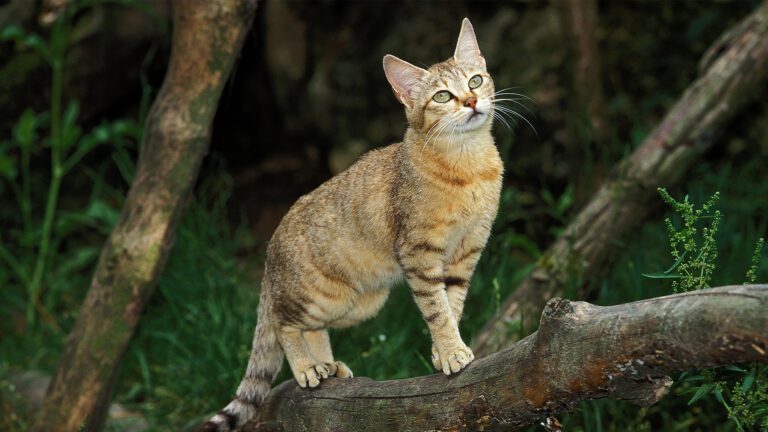
In my early years as a pre-vet student, I had the opportunity to visit the Audubon Nature Institute, a research facility in Louisiana that does important conservation work. At the time, they had a colony of African wildcats that really made an impression on me.
I learned that our domesticated feline companions descend from this single wild species. Whether you have a purebred Maine Coon or a mixed-breed shelter cat, its foundational ancestry can be traced back to the same North African and Near Eastern wildcat populations that were domesticated roughly 10,000 years ago.
Wait…Is that your Tabby?
One of the first things that strikes people about the African wildcat is its appearance. At a glance, it can look remarkably similar to a tabby house cat.
Their relationship with humans stretches back thousands of years, when wildcats began taking advantage of rodents attracted to early human settlements and stored grain.
From a veterinary perspective, this connection is fascinating because many of the behaviors we recognize in our cats today—stalking, pouncing, scent marking, grooming, and a preference for solitary hunting—have deep evolutionary roots.
Small Package, Serious Predator
African wildcats are relatively small compared with many of Africa’s other predators, but their size can be deceptive. They are superb hunters.
Their long legs help them move efficiently across open terrain, while their keen hearing allows them to detect the movements of small prey. Their coats provide camouflage, typically ranging from sandy or grayish tones to reddish-brown, with darker markings that help break up their outline.
Their ears are particularly useful pieces of biological equipment. Like domestic cats, African wildcats can use their ears to detect subtle sounds and help pinpoint where prey is hiding.
And then there are the eyes. Like other cats, they have excellent low-light vision, an essential advantage for an animal that may hunt around dawn, dusk, or during the night.
Born to Pounce
Powerful hind limbs, flexible joints, sharp claws, sensitive whiskers, and specialized teeth all work together to make the cat an efficient predator.
Even the seemingly simple act of grooming has multiple functions. It helps maintain the coat, removes debris, and contributes to scent management.
Drink Water? I’d Rather Have a Mouse
African wildcats can survive in environments where water isn’t always readily available. They obtain much of their moisture from their prey, although they will drink when water is accessible.
As a veterinarian, I have also found that cats who eat wet food tend to drink less water. Sometimes, clients will think this is abnormal, but these cats are getting much of their moisture from their diet. Cats on a dry-food diet, on the other hand, will typically drink noticeably more.
I Love you…Now Give me some Space
African wildcats are generally solitary animals, particularly outside the breeding season.
A cat may love its human family while still valuing personal space. It may enjoy affection one moment and decide it has had enough the next.
From a behavioral standpoint, respecting those signals is important. Cats are individuals, but their underlying behavioral repertoire has been shaped by a long history of solitary hunting.
As a veterinarian, I find it remarkable that our cats can share our homes and become part of our families while still carrying the instincts and spirit of the wild ancestors from which they came.
Any content, resident submissions, guest columns, advertisements, and advertorials are not necessarily endorsed by or represent the views of Best Version Media LLC (BVM) or any municipality, homeowners associations, businesses, or organizations that this publication serves. BVM is not responsible for the reliability, suitability, or timeliness of any content submitted, inclusive of materials generated or composed through artificial intelligence (AI). All content submitted is done so at the sole discretion of the submitting party.