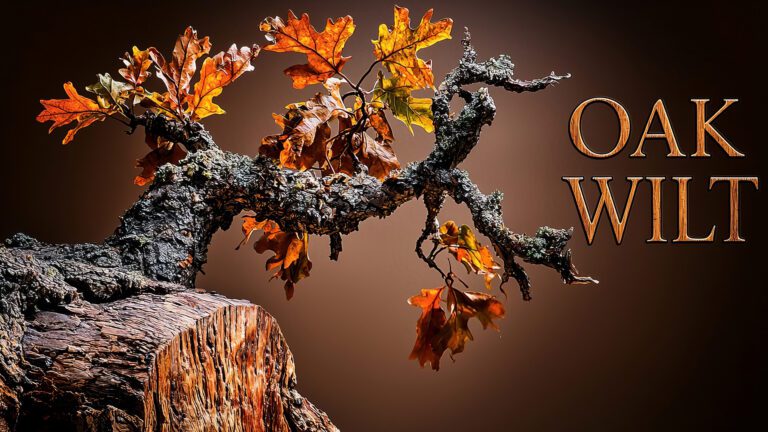
Oak Wilt is one of the most destructive tree diseases in North America. Caused by the invasive fungus Bretziella fagacearum, this vascular wilt disease can kill a healthy oak tree in a matter of weeks. While all oaks are susceptible, those in the red oak group (like Northern Red and Pin Oak) are particularly vulnerable, often dying within a single season, whereas the white oak group (like Bur and White Oak) may survive for several years with localized damage.
What is Oak Wilt?
The disease works by invading the tree’s water-conducting vessels. As the fungus grows, the tree attempts to protect itself by producing gummy plugs designed to stop the spread of the pathogen. Ironically, these plugs also prevent the flow of water and nutrients. This leads to systemic wilting, where the leaves turn bronze or brown starting from the outer edges and eventually drop while still partially green.
How the Disease Spreads
Oak Wilt spreads through two primary methods: insect vectors and underground through root systems.
(Insects): When an infected red oak dies, the fungus produces “spore mats” under the bark. These mats emit a sweet, fruity odor that attracts nitidulid beetles (sap beetles). As the beetles feed on the mats, they pick up fungal spores. The insects then fly to a healthy tree with an open wound—often caused by pruning, storms, or construction—and they transmit the fungus directly into the tree’s vascular system.
Underground (Root Grafts): This is the most common way the disease moves through a grove of trees. Oaks of the same species often share interconnected root systems called grafts. Once one tree is infected, the fungus can travel through these “natural pipelines” to neighboring trees, creating a rapidly expanding “wilt center.”
Critical Steps for Prevention
Prevention is the most effective tool against Oak Wilt, as there is currently no cure once a tree is systemically infected.
Avoid Pruning in Spring and Summer: This is the golden rule of Oak Wilt prevention. Beetles are most active from April through July. Avoid any pruning or wounding of oak trees during this window. If a tree is damaged by a storm, immediately paint the wound with latex paint or pruning sealer to create a physical barrier against beetles. The safest time to prune is during the late fall and winter months, when average temperatures are below 40 degrees F.
Manage Firewood: Never move oak firewood from an unknown source. Fungal mats can remain active on wood for up to a year. If you must move wood, ensure it has been debarked or dried for at least two years. Cover firewood that is known to be infected.
Root Graft Disruption: If Oak Wilt is identified in a neighborhood, professionals can use a vibratory plow or trencher to cut root connections between infected and healthy trees. This creates a “break” that helps stop the underground spread.
By remaining vigilant and following proper pruning cycles, homeowners and land managers can protect these majestic giants and ensure the health of our forest ecosystems for generations to come!
Any content, resident submissions, guest columns, advertisements, and advertorials are not necessarily endorsed by or represent the views of Best Version Media LLC (BVM) or any municipality, homeowners associations, businesses, or organizations that this publication serves. BVM is not responsible for the reliability, suitability, or timeliness of any content submitted, inclusive of materials generated or composed through artificial intelligence (AI). All content submitted is done so at the sole discretion of the submitting party.