When the Waukesha/Milwaukee area was hit by a “100-year flood” in 2008, many homeowners experienced major property damage, resulting in remediation, remodeling, loss of personal items, and replacement of mechanical systems – such as water heaters and HVAC equipment.
After the cleanup and insurance claims were settled, most people figured they’d never have to deal with such a miserable experience again. That’s the next generation’s problem to deal with in 100 years!
But wait – what happened in August of 2025? Or April of 2026? As Yogi Berra said, “It’s like déjà vu all over again.”
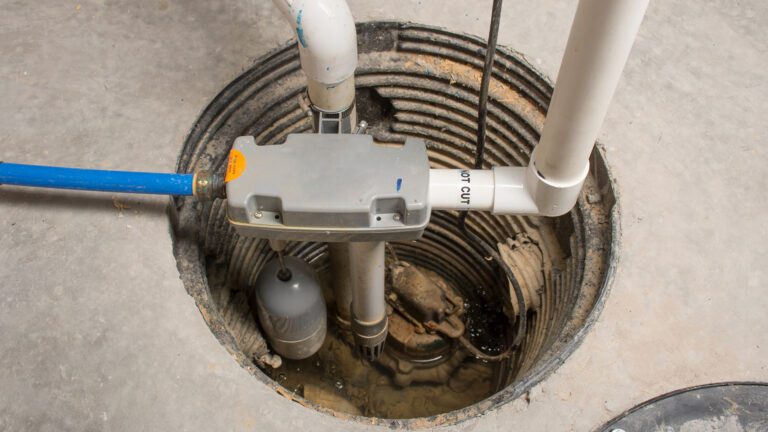
Repeated flood events have caused more and more homeowners to assess their ability to combat Mother Nature. A main focus: their sump pump.
So, what are the main issues to consider?
The first thing to check is your sump pump’s age. Maybe you don’t know exactly what year it was installed, but if “it’s been in there since we moved in ‘X’ years ago” is the answer, it’s probably time to replace it. Another factor to consider is how often the pump runs. Some lucky homeowners can boast that their pump never runs, even during flood events. Others may notice their pump cycles steadily in spring or during heavy rains but rarely ever the rest of the year. Then there are homeowners whose pump runs daily. The more you rely on your pump, the more important it is to maintain it.
Frustrated homeowners dealing with a worn-out pump often call plumbers and say, “I want a bigger pump,” but that’s rarely the answer. More important than horsepower is the “curve,” or how much water the pump will remove at a certain lift. A quality 1/3 HP pump sold by a professional plumber will typically pump more water than a cheaper 1/2 HP pump from a big-box store. Bigger is not necessarily better.
Other factors to consider if you’re not removing water faster than it’s entering your sump crock include adding a second pump in the same crock or upsizing the pump per a licensed plumber’s recommendation. Adding a second pump may require a separate discharge pipe or upsizing the pipe because there’s a limit on how much water a given pipe can handle. And sometimes, a single sump crock is not enough, and breaking up the floor and installing a second or even third sump crock with pumps in a different part of the basement is the answer.
Heavy rain often leads to power outages, prompting homeowners to seek advice. By far, the best (and costliest) option is a whole-house natural gas or an LP-powered generator. If the power goes out, your sump pump will still run. A less costly solution is to add a battery-backup sump pump. We find that a packaged system consisting of a controller, battery, and two pumps, an AC and a DC, is best because during heavy rain events when the power is still on, the DC pump will kick in to assist the primary AC pump, almost doubling the capacity.
We recommend discussing options with a licensed plumber before the next emergency arises. As always, remember, quality and reliability come at a price – the big-box pump will be cheaper, but those savings are quickly blown away, along with your mood, as you’re hauling your flooded possessions to the curb again.
Any content, resident submissions, guest columns, advertisements, and advertorials are not necessarily endorsed by or represent the views of Best Version Media LLC (BVM) or any municipality, homeowners associations, businesses, or organizations that this publication serves. BVM is not responsible for the reliability, suitability, or timeliness of any content submitted, inclusive of materials generated or composed through artificial intelligence (AI). All content submitted is done so at the sole discretion of the submitting party.