As a parent, it’s fun to dream about your child growing up to be an Olympic athlete, a brilliant scientist or the president of the United States. But at the end of the day, most of us just want our children to grow up to be kind, caring people.
Raising compassionate children sounds simple enough; if you care for others, you hope that your little ones will do the same. However, research indicates that while children may be wired to treat others with empathy, whether or not they develop a strong sense of compassion largely depends on their interactions with people like parents, teachers and friends.
Compassion is one of the many positive character traits teachers at Primrose schools foster using the Balanced Learning® curriculum. Character development is woven into daily lessons to help children learn in ways that are age-appropriate and understandable through books, songs, role-playing with the Primrose Friends and other parts of the daily classroom experience.
It’s never too early to start nurturing good character in children at school, at home and beyond. Looking for ways to foster compassion and empathy in your child? Give these inspirational ideas a try.
Model Compassion
Modeling is an effective way to instill positive character traits in young children. Children are constantly watching the adults in their lives for cues on how to behave and interact with others. As a result, actions often speak louder than words.
Simple acts of compassion, like helping a neighbor with their groceries or calling a relative to check on their health, help your child see real-life examples of this value from a person they want to be like — you. Showing compassion to others, whether they’re friends and family or people you might not even particularly like, sets a strong example.
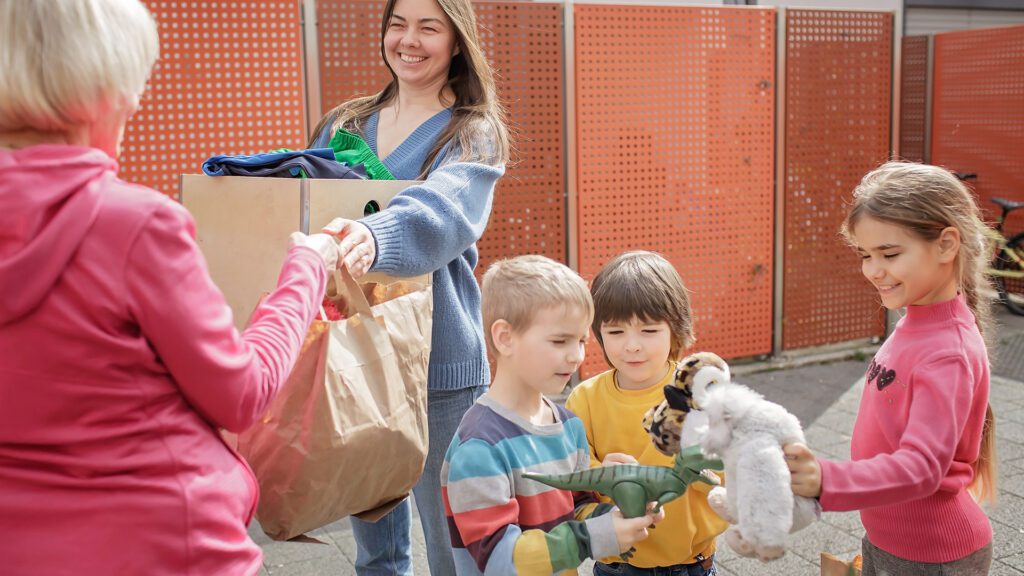
Want to take modeling one step further? Try volunteering together! Your child will experience firsthand how good it feels to help others, and it will give you an opportunity to talk about the many ways they can make a positive difference in the world. For ideas on how you can volunteer with your child, read how Primrose schools help teach children the concept of “giving without expectation” and how even the youngest children put the lesson into action.
Make Caring for Others a Routine
Your child’s daily routine is full of opportunities for them to practice compassion. Model manners at the dinner table, hold the door open for others, say please and thank you and encourage children to do the same. Try to always speak kindly and respectfully to other family members and remind your little one to treat others the way they would like to be treated.
You can make compassion a habit by creating a dinnertime ritual where each family member shares one caring gesture they did or received that day or says something nice about a family member or friend.
Read and Discuss
One of our favorite ways to introduce more abstract concepts like positive character traits is through reading. Og® the bookworm, one of the 12 Primrose Friends that help children develop good character, loves to read! Use Og’s book recommendations to encourage kindness in your little one:
I Love You, Little One by Nancy Tafuri
I Can Share by Karen Katz
When I Care About Others by Cornelia Maude Spelman
Hands Are Not for Hitting by Martine Agassi
A Chair for My Mother by Vera B. Williams
As you read together, take the learning one step further by helping your child think critically about what’s happening in the book. Ask open-ended questions, such as:
How do you think that made the character feel?
Was that a nice way to act or a mean way to act?
Why do you think the character did that?
How do you feel when people are nice to you?
Check out our parent resources for more tips on nurturing positive character traits, such as cooperation and gratitude, in your child.
To learn about Primrose School of Shady Hollow, visit www.PrimroseShadyHollow.com or call 512-282-2341. For more helpful parenting tips and information, visit our blog at www.PrimroseSchools.com/blog and sign up for the Pointers for Parents newsletter.
Any content, resident submissions, guest columns, advertisements, and advertorials are not necessarily endorsed by or represent the views of Best Version Media LLC (BVM) or any municipality, homeowners associations, businesses, or organizations that this publication serves. BVM is not responsible for the reliability, suitability, or timeliness of any content submitted, inclusive of materials generated or composed through artificial intelligence (AI). All content submitted is done so at the sole discretion of the submitting party.