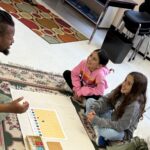
Montessori math is grounded in the belief that children learn best through hands-on discovery and meaningful, real-world experiences. Rather than introducing numbers as abstract symbols from the outset, this approach invites students to explore mathematical concepts in a tangible way. In the early years, children engage in sensorial activities that allow them to see, touch, and physically experience quantity and pattern. From there, they move into working with concrete materials – carefully designed tools that represent mathematical ideas in visible and manipulable forms – before ultimately transitioning to abstract reasoning with numbers and symbols. This intentional progression helps students develop not only competence, but also genuine confidence and curiosity in math.
In the primary classroom (ages 3-6), concrete math materials are thoughtfully introduced to meet children exactly where they are developmentally. Tools such as counting beads, number rods, and golden bead materials give students a clear, physical representation of numerical value and operations. These materials are not simply teaching aids; they are foundational experiences that support deeper understanding over time. A child who has built numbers with their hands, grouped and exchanged quantities, and physically experienced addition and subtraction develops a far more lasting comprehension than one who has only memorized steps or formulas. These early encounters also lay the groundwork for more advanced concepts, including multiplication, division, fractions, and squaring and cubing in later years.
By beginning with concrete exploration, students come to understand not just how math works, but why it works. They learn to see relationships between numbers, recognize patterns, and develop strong number sense. This foundation becomes especially important as they progress into more complex problem solving. Rather than approaching math as a set of isolated procedures, Montessori students view it as a connected, logical system that they can navigate with confidence.
Equally important is the emphasis on applying math in meaningful contexts. Through real-life problem solving, collaborative presentations, and opportunities to teach and learn from one another, students deepen their mastery of concepts. Explaining their thinking to peers reinforces understanding, while also building communication and critical thinking skills. These experiences help ensure that knowledge is retained and can be applied flexibly, rather than forgotten after a test.
As students move into elementary and middle school, the Montessori approach continues to evolve while maintaining its core principles. Daily math practice is a regular part of the routine, but the focus remains on understanding rather than rote memorization. Students are encouraged to analyze their work, identify errors, and reflect on the reasoning behind each step. Mistakes are viewed not as failures, but as valuable learning opportunities – an essential mindset for long-term academic growth.
While mathematics is often associated with single correct answers, students are guided to recognize that there are often multiple pathways to reach a solution. Class discussions frequently center on comparing strategies, evaluating efficiency, and understanding different perspectives. This emphasis on process over product fosters flexible thinking and empowers students to approach challenges with creativity and resilience.
At The Village School in Waldwick, this philosophy extends beyond the math classroom. Educators are committed to meeting each child where they are, allowing them to progress at a pace that is both supportive and appropriately challenging. Individualized lesson planning ensures that every student, whether they need reinforcement or are ready for advanced material, remains engaged and motivated. This personalized approach helps cultivate independence, self-awareness, and a strong sense of ownership over learning.
By the time students graduate, they leave with more than just a solid foundation in high school mathematics. They carry with them the ability to think critically, solve problems with confidence, and advocate for themselves when they need support. Perhaps most importantly, they develop a lasting understanding that math is not something to be feared or memorized, but a dynamic and accessible tool for making sense of the world around them.
Any content, resident submissions, guest columns, advertisements, and advertorials are not necessarily endorsed by or represent the views of Best Version Media LLC (BVM) or any municipality, homeowners associations, businesses, or organizations that this publication serves. BVM is not responsible for the reliability, suitability, or timeliness of any content submitted, inclusive of materials generated or composed through artificial intelligence (AI). All content submitted is done so at the sole discretion of the submitting party.