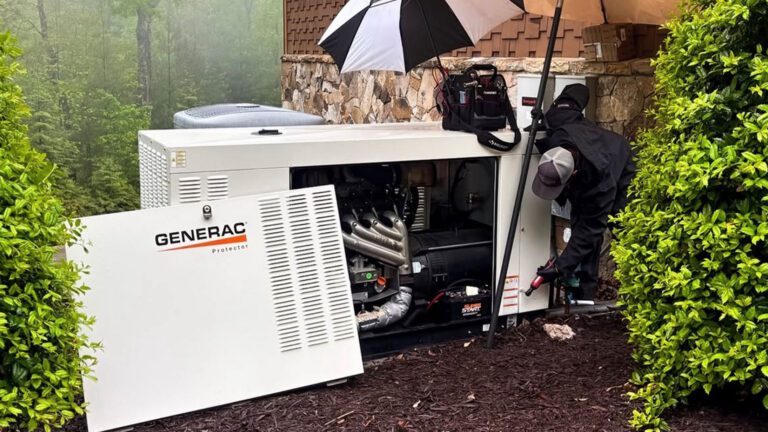
When discussing home standby generators, there are two very different categories: air-cooled generators and liquid-cooled generators. I’m going to explain to you the differences between the two.
Air-cooled generators are exactly as they sound—the engine is cooled by moving fresh air from the outside, through the unit, over the engine, and out the exhaust panel. Riding lawn mowers and motorcycles have air-cooled engines. Many air-cooled generators have a minimum clearance on the intake and exhaust sides of the units of 3 ft. or more. This clearance is needed to bring fresh, cool air on the intake side and force the cool air over the engine and out the exhaust panel. It is important to keep the intake and exhaust sides clear of any obstructions to prevent restricting the air flow. If a generator is installed too close to the side of the house, fence, or bushes, the air flow could be restricted, causing the unit to overheat.
Due to the nature of cooling the engine with air, air-cooled generators tend to consume some of their engine oil during extended run times. Typically, an air-cooled generator can run for three days before consuming the engine oil and shutting down due to low oil pressure. The amount of time an air-cooled generator can run without needing oil added is directly related to how much power the end user is pulling out of the generator. During an extended outage, it is recommended to shut air-cooled generators down after 24 hours of continuous run time, check the oil, top it off if necessary, and put it back into service.
Liquid-cooled generators have automotive style engines with a cooling system, including a radiator and thermostat. Liquid-cooled generators use coolant or antifreeze in combination with the radiator and thermostat to regulate the temperature of the engine in the generator. With an automotive style cooling system, liquid-cooled generators can run much longer without the need to shut them down to top off oil. Due to the ability to control the engine temperature, liquid-cooled generators do not consume much, if any, oil during extended run times. Although liquid-cooled generators regulate their own heat, they still require clearance around the generator to dissipate the heat away from the generator.
Having automotive style engines and cooling systems does make the liquid-cooled generators considerably more expensive than air-cooled generators. Deciding which generator is best for your application depends on how involved you want to be with the generator during extended outages. If you have any questions, please reach out to us.
Any content, resident submissions, guest columns, advertisements, and advertorials are not necessarily endorsed by or represent the views of Best Version Media LLC (BVM) or any municipality, homeowners associations, businesses, or organizations that this publication serves. BVM is not responsible for the reliability, suitability, or timeliness of any content submitted, inclusive of materials generated or composed through artificial intelligence (AI). All content submitted is done so at the sole discretion of the submitting party.