Vehicle Defense. Tactical Vehicle Defense. Defensive Vehicle Workshop. Dynamic Vehicle Defense Tactics. Vehicle Close Quarters Battle. Tactical Defensive Vehicle Workshop. It reminds me of the scene in Monty Python’s Life of Brian, when they’re sitting in the colosseum discussing the People’s Front of Judea vs. the Judean People’s Front vs. the Popular Front of Judea.
It is both exhausting and ridiculous.
It is also assumed that any form of “vehicle” defense course is the purview of steely-eyed, supercharged operators from some special unit somewhere, decked out in military gear and body armor, and sporting magnificently groomed beards.
We are constantly reminded that “cars don’t make good cover.” Everyone nods in agreement, temporarily spellbound by receiving such a spiritual-like nugget of wisdom.
Ya don’t say!
The thing is, in a street environment, the only immediate cover available is going to be… drum roll please
You nailed it! Cars. Yours, or someone else’s.
There are approximately 21 million active concealed carry licenses in the U.S., and the true number of people carrying is higher still, since a growing number of states no longer require a permit. These people are arguably in more need of vehicular training and education than anyone:
- That 50-something woman who never managed to lose that baby weight from 10 years ago and puts her everyday carry firearm in the center console.
- That 40-something skinny-fat guy who suffers from dadbod and now carries hip, not appendix (at the front of his waistband).
- That 70-something grandfather whose mobility is reduced because of that hip replacement he had last year.
- That 20-something new concealed carrier who’s been shooting since they were 10 years old.
All these types of concealed carriers still require training for driving while concealed carrying. The reason why so many stay away from it is because they think it’ll be too hard, they won’t be capable of doing it, they’re not worthy, or they’ll feel like imposters, because only Tier 1 ninjas train in vehicles…right?
Wrong!
Blending together the use of a firearm with a vehicle has, over the years, been hijacked by those who seek to overcomplicate what is basic common sense. Yes, there might be limitations due to the physical mobility issues of the shooter, but that’s where flexibility of techniques comes into play. Find another way of doing it that works for the particular person—that is the job of the instructor.
When teaching this subject to our people, only two things truly matter to us:
- That they understand the difference between reacting to something and initiating something.
- That we provide workaround options for any physical mobility limitations they might have.
We have husbands, wives, fathers and daughters who come to us for concealed carry training, inside a vehicle, because they want their sons, daughters and wives to have an understanding of what happens if “dad has to do this.”
We put the non-firing family members in the front passenger seat, rear right seat, rear left seat, and run exercises where the “threat” doesn’t always come from the front (12 o’clock); it might come from rear right (5 o’clock), or rear left (7 o’clock). How do they engage that threat with their 10-year-old daughter sitting rear left or rear right?
We show them how to do something and, more importantly, why it is done in a certain way. We educate the non-firing family members. We don’t dress it up in fluff and rainbows; we tell the non-carrying family members:
“These are the responsibilities your Mom/Dad/Husband/Wife has to keep you safe.”
“They own their responsibilities, and you need to know what that ownership looks and sounds like.”
“The world can be dangerous. To believe otherwise is naïve and makes you a potential victim.”
It is as important, if not more important, for normal families to have this training as it is for an armed surveillance operator or an undercover soldier or cop.
People sometimes ask me, “But is it dangerous…?”
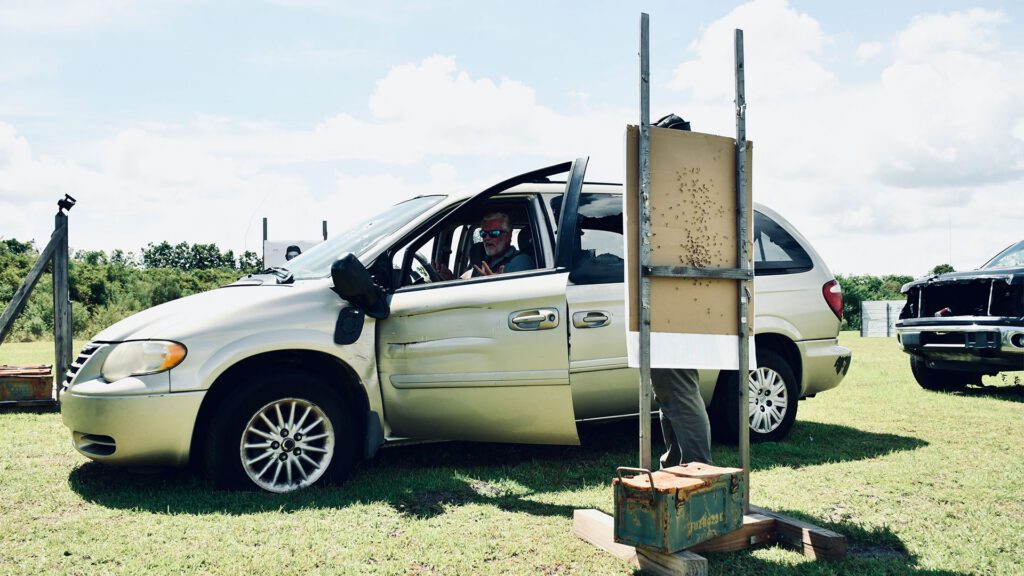
Yeah, it can be, but only if you don’t really know what you’re doing, or if you overcomplicate simple procedures. If you’re spending 45 minutes explaining to a student how to take their seatbelt off, to exit a car, then you probably fall into one of those two categories. Everything we teach, including vehicle-based training, is based on our Street Scene System of Training (SSST). It’s messy, simple, unchoreographed and adaptable, and it’s influenced by just a teensy-weensy bit of experience of having spent long hours in cars, in nasty places, over many years.
It is a privilege for us to be bestowed with the responsibility of training families. Some of the families who train with us have been with us for three years, with children as young as nine. The responsibility of that can sometimes feel overwhelming, but they trust us implicitly now because we treat them all like part of our own family.
“Practice what you’re not good at.” — John “Lofty” Wiseman (22 SAS)
Neil M. Davis QCVS is a highly decorated, retired sergeant major of a covert British Army counter-terrorist unit. He is the training director and chief instructor for Go Noisy USA, LLC, which specializes in tactical firearms training, specifically for street-based environments. Go Noisy USA (www.gonoisy.com) is owned by his wife, Tsarina.
Any content, resident submissions, guest columns, advertisements, and advertorials are not necessarily endorsed by or represent the views of Best Version Media LLC (BVM) or any municipality, homeowners associations, businesses, or organizations that this publication serves. BVM is not responsible for the reliability, suitability, or timeliness of any content submitted, inclusive of materials generated or composed through artificial intelligence (AI). All content submitted is done so at the sole discretion of the submitting party.