What anxiety, ADHD, brain fog and overwhelm may be telling you about your brain
We tend to think of symptoms as separate problems. Trouble focusing is one problem. Anxiety is another. Poor sleep, brain fog, irritability and feeling overwhelmed are others.
But after more than 20 years of caring for families in Port Washington, I have learned that sometimes these symptoms are different ways the brain and nervous system are telling us the same thing: “I’m having trouble regulating.”
The question is, why?
Symptoms Don’t Tell Us Everything
Think about anxiety. One person may feel constantly worried and unable to shut their brain off. Another may experience physical tension or difficulty sleeping. A child may not describe what they are feeling as anxiety at all. Instead, they may be irritable, emotional, unable to sit still or have difficulty transitioning between activities.
The symptoms are real, but they don’t necessarily tell us what is happening underneath them.
The same is true with attention problems. Two people can both struggle with focus, yet their brains may be functioning very differently.
That is one reason I became so interested in brain mapping and neurofeedback. Instead of only asking, “What symptoms are you experiencing?” we can also ask, “What is your brain actually doing?”
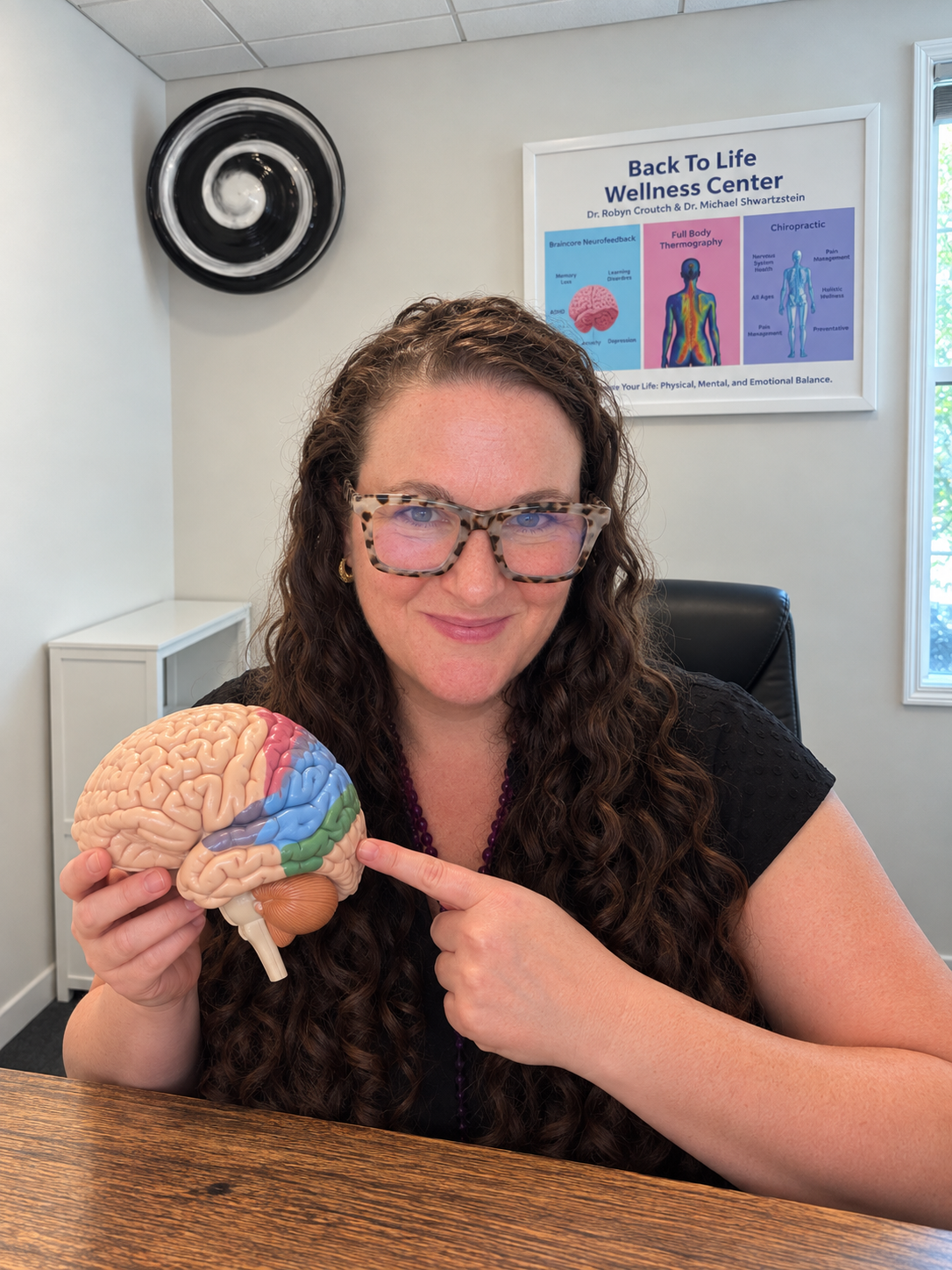
Submitted photo
A Window Into Brain Function
A qEEG brain map is a non-invasive way of measuring the electrical activity of the brain. We record brainwave activity and compare the results with a database of people of the same age.
Brainwaves aren’t good or bad. We need all of them. What matters is whether the brain can produce the appropriate activity at the appropriate time.
Slower brainwave activity is important for rest and sleep. Faster activity helps us concentrate, think and respond. Problems can occur when the brain has difficulty shifting between these states.
Imagine trying to fall asleep while your brain is still behaving as though you need to solve a problem. Or trying to concentrate while your brain keeps drifting into a slower state.
Suddenly, symptoms like poor sleep or difficulty focusing begin to make more sense.
Your Brain Can Learn
One of the things I love most about the brain is its ability to change. This is called neuroplasticity.
Neurofeedback uses this ability to help train the brain toward more balanced patterns of activity. During a session, the brain receives feedback about its own activity. With repetition, it can learn more efficient patterns.
I often describe it like exercise for the brain. You don’t go to the gym once and expect your muscles to completely change. Training happens through repetition. The same concept applies to the brain.
You Are Training Your Brain Every Day
Formal brain training is only one piece of the puzzle. What we do every day also influences our brain and nervous system.
Sleep matters. Movement matters. Nutrition matters. Spending time outside and connecting with other people matters.
So does what we expose our nervous system to all day. Many of us wake up and immediately look at our phones. We move from texts to emails to social media to work, constantly receiving information. Our brains rarely get a moment without stimulation.
Creating small periods of quiet can make a difference. Take a walk without your phone. Spend a few minutes breathing slowly. Get outside in the morning. Move your body. Prioritize sleep. Eat foods that nourish your brain.
And remember, your brain isn’t separate from the rest of your body. It actually controls everything. Your brain, spinal cord and nerves make up your nervous system, which is constantly communicating with every part of your body. This is why I have always viewed chiropractic care as being about much more than back or neck pain. Supporting healthy nervous system function is an important part of overall wellness.
Start Getting Curious
Instead of becoming frustrated with your brain because you can’t focus, can’t sleep or feel anxious, start getting curious.
What might your brain be trying to tell you?
Maybe you need more sleep or movement. Maybe your nervous system needs more opportunities to shift out of constant stimulation. Sometimes, it may be helpful to actually look at how your brain is functioning.
We spend a tremendous amount of time thinking about heart health, gut health, hormones and fitness, but we sometimes forget that the brain and nervous system play a role in regulating and coordinating all of these systems. Brain health deserves to be at the center of that conversation too.
The goal isn’t to have a brain that never feels stressed, distracted or tired. Those are normal human experiences.
The goal is flexibility: a brain and nervous system that can respond when life demands more from us and then settle again when the demand has passed.
After all, your brain is talking to you every day.
Maybe it’s time we started listening.
About Dr. Robyn Croutch and Dr. Michael Shwartzstein
Dr. Robyn Croutch has been in private practice since 2001 and has been serving the Port Washington community for 21 years. She and Dr. Michael Shwartzstein practice together at Back to Life Wellness Center, where they work with children and adults using chiropractic care, qEEG brain mapping, neurofeedback and thermography to support brain, nervous system and overall wellness.
Any content, resident submissions, guest columns, advertisements, and advertorials are not necessarily endorsed by or represent the views of Best Version Media LLC (BVM) or any municipality, homeowners associations, businesses, or organizations that this publication serves. BVM is not responsible for the reliability, suitability, or timeliness of any content submitted, inclusive of materials generated or composed through artificial intelligence (AI). All content submitted is done so at the sole discretion of the submitting party.