Dental implants have become so common that it’s easy to assume they are a relatively recent invention. In reality, their story began more than 70 years ago—and quite by accident.
In 1952, a Swedish scientist studying blood flow in rabbit bone placed a small titanium chamber in the bone, intending to remove it later. Instead, he discovered that the titanium had permanently fused with the surrounding living bone. That unexpected discovery, later known as osseointegration, became one of the most important breakthroughs in modern dentistry and remains the foundation of dental implant treatment today.
The first titanium dental implant was placed in a human patient in 1965, and it remained functional for the rest of that patient’s life. Since then, implant technology and surgical techniques have advanced considerably.
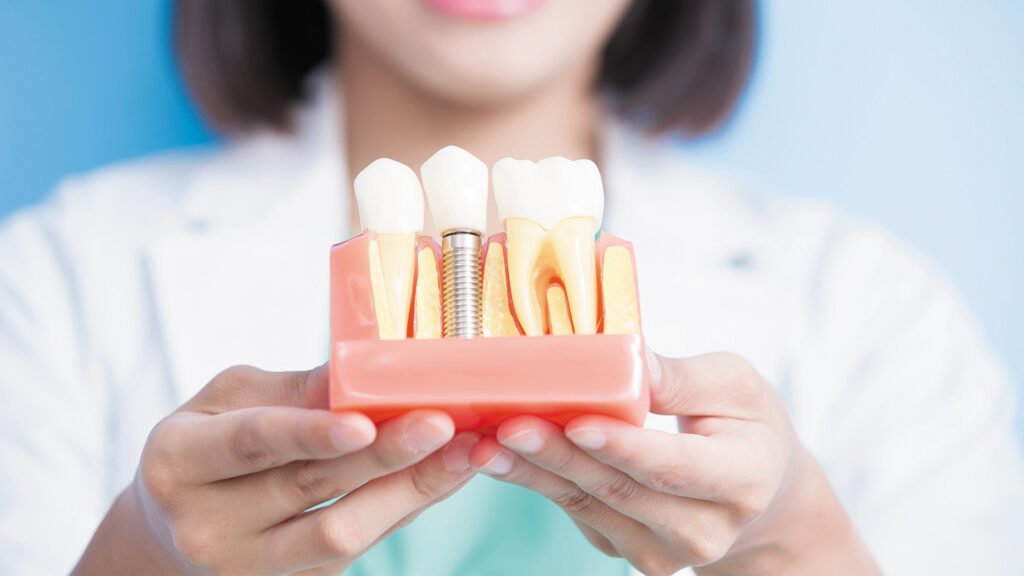
In simple terms, a dental implant is a small titanium post that replaces the root of a missing tooth. An oral surgeon places the implant into the jawbone, where it gradually fuses with the surrounding bone. Once healing is complete, a dentist attaches a crown—the visible, tooth-shaped portion of the restoration—to the implant.
Implants can be used to replace a single missing tooth, several teeth, or to help stabilize a full set of dentures. The best option depends on several factors, including a patient’s oral health, bite, available bone, overall treatment needs and budget.
The Sneaky Problem: Disappearing Bone
There is an important consequence of tooth loss that many people do not realize: the jawbone beneath a missing tooth begins to change soon after the tooth is lost.
A tooth’s root stimulates the surrounding bone through normal chewing forces. When that stimulation disappears, the bone can gradually shrink. If too much bone is lost, there may not be enough healthy bone to securely support a dental implant.
The good news is that “not enough bone” is rarely the end of the story anymore. There are now excellent ways to rebuild the foundation needed for successful implant placement.
Bone Grafting: Rebuilding the Foundation
Bone grafting can be thought of as creating a new foundation for an implant. Oral surgeons have several types of grafting materials available, depending on a patient’s individual needs. These may include:
- Autogenous bone — the patient’s own bone, taken from another area of the body
- Human donor bone — processed and sterilized bone obtained from a tissue bank
- Animal-derived bone — commonly bovine-derived material that has been specially processed and purified
- Synthetic materials — manufactured bone substitutes that may be appropriate in certain situations
In some cases, surgeons use a combination of materials. The goal is to encourage the body to regenerate bone in the precise area and shape needed to support an implant.
This process is known as guided bone regeneration (GBR). When appropriate, grafting can sometimes be performed at the time a tooth is removed, helping preserve the jawbone and prepare the site for a future implant.
Sinus Lifts: Addressing a Challenge in the Upper Jaw
The back portion of the upper jaw presents another unique challenge. The bone in this area lies directly beneath the maxillary sinuses, which are air-filled spaces within the skull.
When bone is lost after tooth removal, the sinus can gradually expand downward into the area where the bone once was. A sinus lift can address this problem by gently elevating the sinus lining and placing bone-grafting material in the space created beneath it.
Over time, the graft develops into new bone, creating additional support for an implant. Depending on the specific technique and the patient’s anatomy, healing may take several months.
Advances in sinus-lift techniques have also made the procedure more predictable and, in many cases, more comfortable than patients might expect. In certain situations, an implant can even be placed at the same time as the sinus augmentation, potentially shortening the overall treatment timeline.
Healing Help From Your Own Blood
One of the more interesting advances in modern oral surgery uses something that comes directly from the patient: their own blood.
A small blood sample can be processed in a centrifuge to concentrate platelets and growth factors involved in the body’s natural healing process. Two commonly used preparations are platelet-rich plasma (PRP) and platelet-rich fibrin (PRF).
PRF, in particular, can provide a gradual release of growth factors at the surgical site and can also help support the graft as healing takes place. Depending on the procedure and the patient, these materials may help promote healing and reduce postoperative swelling and discomfort. Not bad for something your body was making anyway.
Precision Planning With Guided Surgery
Modern implant treatment also benefits from advances in digital imaging and surgical planning.
A 3-D cone beam CT (CBCT) scan allows the oral surgeon to view the jaw in three dimensions and evaluate the available bone, surrounding structures and other important anatomy. The information can then be used to digitally plan the precise depth, angle and position of an implant before surgery begins.
In appropriate cases, that digital plan can be used to create a custom surgical guide. A surgical guide is a type of template that helps the surgeon place the implant according to the predetermined plan. This technology can make implant placement more precise and predictable.
The Bottom Line
Dental implant treatment has come a long way since that unexpected discovery in a rabbit bone more than seven decades ago. Advances in implant design, bone grafting, sinus augmentation, digital imaging and techniques designed to support healing have expanded treatment options for many patients.
Someone who may once have been told that they did not have enough bone for an implant may now have several options for rebuilding the area and moving forward with treatment.
Whether you are missing one tooth, several teeth or are struggling with loose dentures, the right approach depends on your individual anatomy, oral health and treatment goals. A conversation with your dentist or oral surgeon can help determine what options are available and which approach is best suited to your needs.
Any content, resident submissions, guest columns, advertisements, and advertorials are not necessarily endorsed by or represent the views of Best Version Media LLC (BVM) or any municipality, homeowners associations, businesses, or organizations that this publication serves. BVM is not responsible for the reliability, suitability, or timeliness of any content submitted, inclusive of materials generated or composed through artificial intelligence (AI). All content submitted is done so at the sole discretion of the submitting party.