Has your dentist or hygienist ever recommended you need a crown, and you’ve questioned why? Perhaps you were shown a photo like Image 1 and you weren’t having any symptoms.
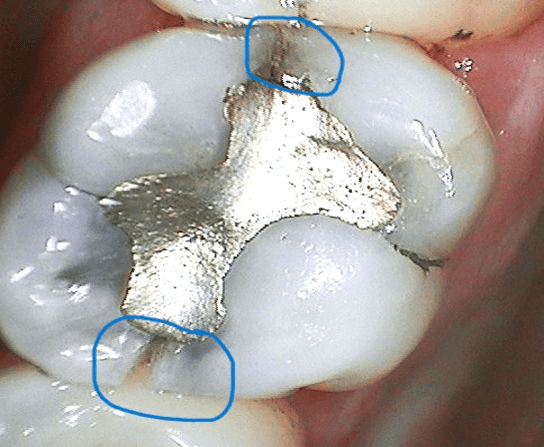
Image 1. (Submitted photo)
Believe it or not, Image 2 is what lurks beneath the tooth shown in Image 1 which appeared to be benign which your oral healthcare provider was recognizing and attempting to prevent additional extensive treatment and potentially removal of a tooth.
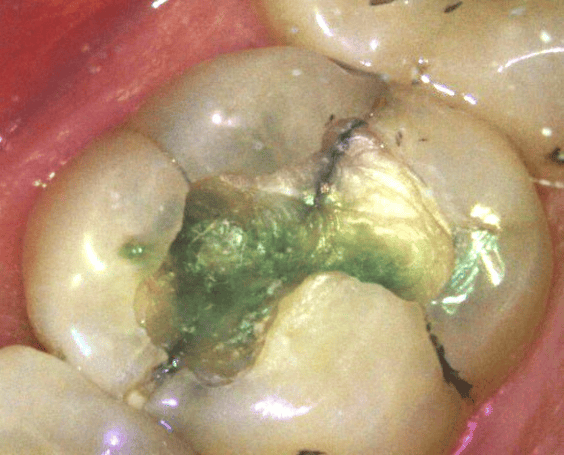
Image 2. (Submitted photo)
Cracked tooth syndrome is caused by grinding, clenching, old amalgam fillings, large cavities, injury to the mouth, or biting and chewing hard things such as ice, nuts or candy. Unfortunately, and all too commonly, fractures can be detected in teeth that have never had a filling or cavity. Symptoms include sharp pain when chewing, hot, cold or sweet sensitivity, and pain that comes and goes with difficulty localizing. These symptoms can be inconsistent and challenging for an oral healthcare provider to diagnose. Most instances, x-rays (two or three-dimensional) lack the diagnostic quality to detect a fracture and a dentist must rely on clinical symptoms, signs and transillumination.
During your 6-month dental examination, your oral healthcare provider and dental hygienist are diligent to evaluate for any fracture lines present. The hygienist may recommend further evaluation of specific teeth which have cracks by utilizing a device called a bite stick or transillumination. A bite stick is basically an elevated “stick” which helps to reproduce any biting discomfort created by a fracture. Transillumination is a non-invasive technique which uses light that helps detect fractures with light refraction. Finally, your dentist my use concentrated cold or hot on the tooth to determine if the nerve is still alive or vital.
In past articles, I have educated our readers on cracked tooth syndrome, but I felt it imperative to discuss this topic again with the most substantial evidence for early detection and treatment of tooth fractures: a clinical photo. With astute visual observation and investigation of clinical signs and symptoms, your hygienist and oral healthcare provider can “stop the crack in its path” and suggest a full coverage crown, inlay or onlay. This more conservative approach, versus “watching for symptoms,” prevents additional treatment like a root canal or an extraction, and even more expensive missing tooth replacement options like an implant or bridge.
Should you have any additional questions about cracked teeth and treatment options please contact our website at www.mequonsmiledesign.com.
Any content, resident submissions, guest columns, advertisements, and advertorials are not necessarily endorsed by or represent the views of Best Version Media LLC (BVM) or any municipality, homeowners associations, businesses, or organizations that this publication serves. BVM is not responsible for the reliability, suitability, or timeliness of any content submitted, inclusive of materials generated or composed through artificial intelligence (AI). All content submitted is done so at the sole discretion of the submitting party.