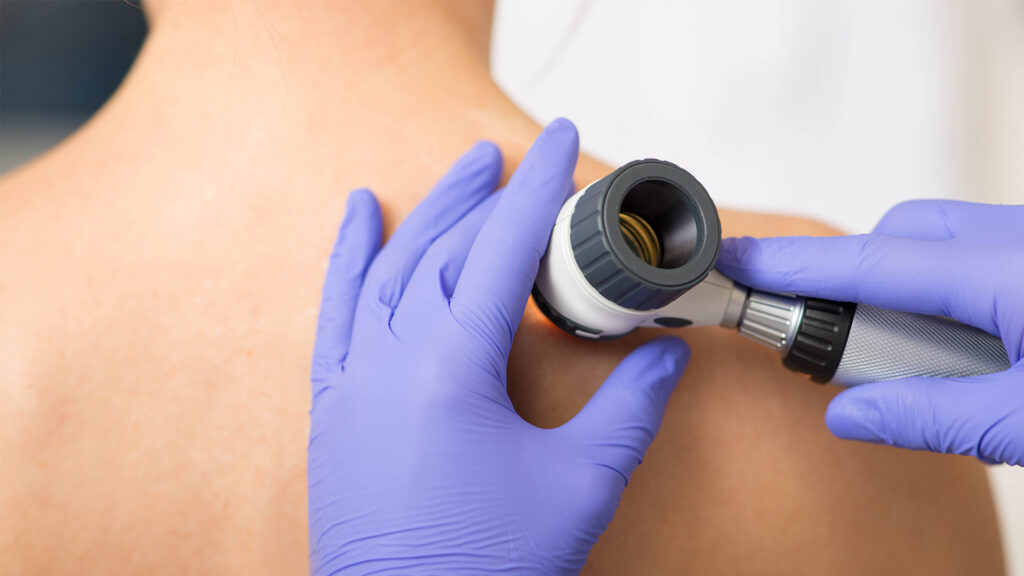
Many people hear “Mohs” and assume it’s an acronym. It’s actually the name of the surgeon who pioneered this technique decades ago, Frederic Mohs. Mohs surgery is a method for removing skin cancer that takes the smallest amount of normal skin necessary while still confirming, before closing the wound, that the cancer is gone.
Taking less normal skin along matters most on what I like to call high-end real estate: the face, the ears, the scalp. In those areas there isn’t a lot of extra skin to work with. A standard excision takes a generous margin and sends it to a lab, and you find out days later whether the cancer is really gone. Mohs lets me check the margin myself, on-site, while the patient is still in the clinic, and keep going only if necessary to completely remove the cancer. It’s precise in a way not replicated by any other surgical technique.
That’s the part of the job I find most satisfying: getting to combine two different skills in the same afternoon. I’m the surgeon removing the cancer, and I’m also the one reading the tissue under the microscope to confirm the margins are clear. Very few fields let you close that loop yourself in real time.
The biggest misconception I run into is about what the procedure itself looks like. Most patients arrive expecting something like their biopsy, a quick shave of a thin piece of skin, repeated until the margins look clear. That’s not really what happens. Mohs surgery uses a scalpel to cut to the fat below the dermis, and once the cancer is out, there’s a defect that has to be repaired. The repair is not generally just pulling the sides of the defect together. It takes a good plan to ensure that the scar is as cosmetically pleasing as possible once the scar has fully matured. Often, the incision is lengthened deliberately to produce a scar that lies flat, lives at cosmetic unit junctions, and settles into the skin’s natural lines running against them. Getting the removal right and getting the reconstruction right are two different disciplines, and a surgeon has to be good at both. A poorly designed and executed repair is the difference between looking like yourself afterward and not, while a poorly read slide is the difference between a clear margin and a recurrence.
That’s also where training matters more than people realize. Not every Mohs surgeon is board certified and not every Mohs surgeon is fellowship trained, which are two different credentials. Fellowship training means a full additional year after residency, performing at least 600 supervised cases before practicing independently. That supervised case load builds real proficiency in both the slide analysis and the reconstructive techniques. Board certification is a separate exam recognized by the American Board of Dermatology as evidence of that proficiency. Neither is legally required to perform Mohs surgery, but both are worth asking about before someone operates on your face.
If a patient asks me what to expect before their surgery date, I tell them: get some sleep, eat a real breakfast, and skip the alcohol for a day or two beforehand. Plan for a long day made up of short bursts of activity and a lot of waiting. The waiting is what the patient is doing while the slides are being produced in the lab. Every piece of tissue I remove goes to our lab for processing before I know whether we’re done, and that happens at every stage if more than one is needed. Bring a book, bring a snack, bring a blanket. The waiting is how I confirm there’s no cancer left on your body, and it’s worth every minute.
Afterward, the most common complication is bleeding, and it’s most likely in the first 48 hours. That’s the entire reason behind the boring-sounding postoperative instructions -no vigorous exercise, no yard work, no manual labor for a bit. There will likely be some bruising and swelling around the site, and that resolves on its own with time. After leaving the clinic it’s the patient’s turn to take good care of their surgical site.
As for where the field is headed, more patients are coming in already knowing to ask about fellowship training and board certification, which tells me the public conversation about credentials is catching up to where it should have been all along. I expect that trend to continue as patients continue to become more informed consumers of their healthcare.
I got into this field because it lets me combine precision surgery with immediate, hands-on confirmation that the job is done right, and because it’s used on the parts of the body where getting it right matters most. Thirteen years of training after high school got me here, and I’d do it again.
Any content, resident submissions, guest columns, advertisements, and advertorials are not necessarily endorsed by or represent the views of Best Version Media LLC (BVM) or any municipality, homeowners associations, businesses, or organizations that this publication serves. BVM is not responsible for the reliability, suitability, or timeliness of any content submitted, inclusive of materials generated or composed through artificial intelligence (AI). All content submitted is done so at the sole discretion of the submitting party.