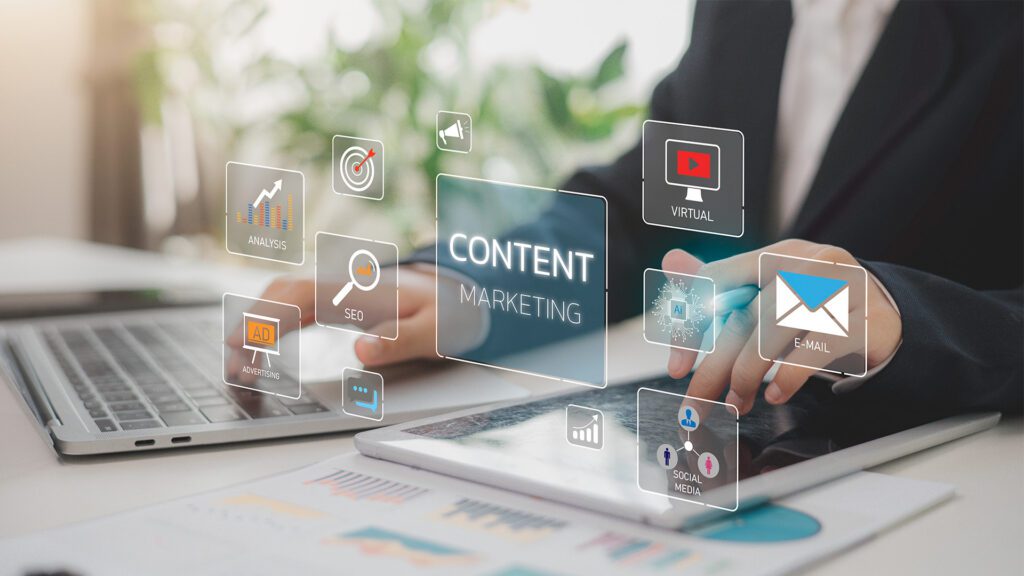
For local businesses and nonprofits, marketing has historically been a game of choosing lines in the sand. A neighborhood bakery might put all its money into direct mail flyers. A boutique down the street might rely entirely on Instagram posts. A nonprofit might rely on direct mail and social media. But in today’s landscape, treating marketing channels like isolated islands is a recipe for wasted budget.
We know that consumers do not live in silos; like us, they hop fluidly between physical spaces and digital screens. To thrive with changing consumer behavior, local marketing can adapt with Integrated Marketing Communications (IMC)—a strategy in which all your channels (social media, email, local SEO, AI and GEO, functional website design, and on and offline advertising) work in perfect lockstep to tell a single, cohesive brand story.
When your marketing channels talk to each other, your business grows. Here is a look at why integration is the ultimate growth engine for local businesses and nonprofits, backed by recent industry research.
1. BREAKING THE “SINGLE-CHANNEL” TRAP
Depending on just one way to reach customers is increasingly risky. Fortunately, local businesses and nonprofits are catching on. According to the Taradel 2025 Small Business Marketing Report, the percentage of small businesses relying on a single marketing channel has plummeted from 24% in 2022 to just 11% in 2025.
When you limit your business to one medium, you miss out on the different ways people make buying decisions. One customer might need to see a local map listing, while another might need an invitation in their mailbox. An astounding 88% of customers expect businesses and nonprofits to respond to online reviews³. An integrated approach ensures you are visible wherever your local audience happens to look.
2. THE 1+1=3 EFFECT (AMPLIFYING YOUR ROI)
The true magic of integrated marketing is that channels do not just run alongside each other—they actively boost one another’s performance. Multi-channel attribution studies published by Improvado indicate that integrated campaigns deliver up to 30% higher ROI compared to siloed approaches.
Think of it as a “marketing flywheel” (Jim Collins; Good to Great, Turning the Flywheel). For example, research from SparkToro shows that earned media (any publicity or exposure that a business receives through unpaid, organic channels such as press coverage, reviews and ratings, social media mentions) builds foundational credibility that actually increases paid advertising by 22%. Local audiences are simply far more likely to take action; click on a Google or Facebook ad, schedule or shop online at a business or nonprofit they have seen consistently in their community. Consistency increases name retention and helps build brand trust and brand love.
This multi-channel synergy creates staggering performance jumps. According to Constant Contact, SMBs using multi-channel strategies see:
- 53% more success in their email marketing campaigns
- 43% better results on paid social media advertising
- 21% stronger results in organic search marketing
When your strategy supports your ad campaigns and social media, and your social media feeds your email list, every dollar you spend works twice as hard. Remember, your website and digital channels are always on and available for customers whenever they’re looking, so you can be seen, found, and chosen.
3. CONSISTENCY DRIVES CASH FLOW
Imagine walking into a local restaurant after seeing a sleek, sophisticated ad online, only to find a chaotic storefront with entirely different branding, messaging, and menu prices. The disconnect triggers instant consumer skepticism. In fact, a report by SuperOffice notes that 60% of customers are likely to churn, or leave, if they experience a disconnected or inefficient experience across a business’s various touchpoints.
Conversely, message consistency builds deep trust over time. The same report highlights that using integrated, consistent messaging across channels can boost overall revenue growth by 20%. When a local business presents “one sight, one sound”—meaning the tone on their website matches their print and digital ad campaigns, which in turn match their in-store or service call experience—they quickly become the obvious, trusted choice in the communities they serve.
4. MAXIMIZING TIGHT BUDGETS
When resources are tight, who can afford to guess which single channel will hit the bullseye? What’s more, research confirms that an integrated marketing approach with multiple channels will hit a much bigger bullseye! An integrated strategy allows you to repurpose content efficiently and track consumer behavior accurately. A single customer success story can be turned into a local press release, used in an ad campaign, clipped into a short video for Instagram, quoted in a monthly email newsletter, added as a review, and optimized on your website to boost local SEO and fuel AI search.
5. MOVING FORWARD
Integrated marketing is no longer a luxury reserved for massive corporate brands; it is a survival and growth mechanism for local businesses and nonprofits. By weaving your digital and traditional threads into a single fabric, you build a recognizable brand, maximize every dollar of your budget, and create a seamless experience that turns local neighbors and visitors into lifelong customers.
Interested in learning more? Please reach out to schedule a complimentary business or nonprofit marketing consultation: jenn@upvalley-living.com | phone/text 707-889-1960
¹, ² “BusinessDasher 109+ Omnichannel Statistics 2026”
³ Salesforce “What are Customer Expectations and How Have They Changed?”
⁴ Reputation x, “2026 Reputation Management Statistics”
Consumer behavior has changed. Gone are the days when customers just call/visit during business hours. Consumers find, choose, research, and book or visit when it fits their schedules, often outside business hours. Your business or nonprofit’s digital presence matters. After all, how many people do you see walking by with their eyes on their smartphone?
Online reviews are important for consumers because they build trust, directly influence purchase decisions for 93% of consumers, and serve as significant ranking factors in local SEO and AI search. AI search is fast becoming the gold standard as it dives into all the digital data about your business or nonprofit online and summarizes it for consumers.
Here’s a link to Reputation X, which provides reputable, up-to-date stats. Three sobering ones:
- Over 92% of consumers hesitate to buy from businesses with no reviews
- 88% of consumers expect businesses to respond to all their reviews
- 82% of consumers read AI-generated review summaries
Any content, resident submissions, guest columns, advertisements, and advertorials are not necessarily endorsed by or represent the views of Best Version Media LLC (BVM) or any municipality, homeowners associations, businesses, or organizations that this publication serves. BVM is not responsible for the reliability, suitability, or timeliness of any content submitted, inclusive of materials generated or composed through artificial intelligence (AI). All content submitted is done so at the sole discretion of the submitting party.